“The podcast where African artists talk with Gillian Solomon about themselves, their culture, their stories, and their art.”
This podcast series aims to reveal how artists resisted becoming what therapist Dr. Aaron Beck calls “Prisoners of Hate” by making imagery pretesting against racism, and conflict.
I came to Africa as (what Australian’s call) a “£10 Pom” from Yorkshire to live in 2nd Ave, Harfield Village, Cape Town. I married, had children and a couple of dogs. We would walk in the late afternoon chatting to neighbours coming home from factories in nearby Lansdowne where many were textile workers. Like my family in Britain where my grandfather had been a wool sorter in a Yorkshire wool factory and played in Brass Band. My Harfield village neighbours paraded the street rehearsing for Carnival, much as my grandfather would return from the pub after playing dominoes until closing time, swaying up Cavendish Street blowing the euphonium he played in Salts Mill Brass band. Waking the street and my grandmother to put his dinner on the table, seeing as cooking was “women’s work”.
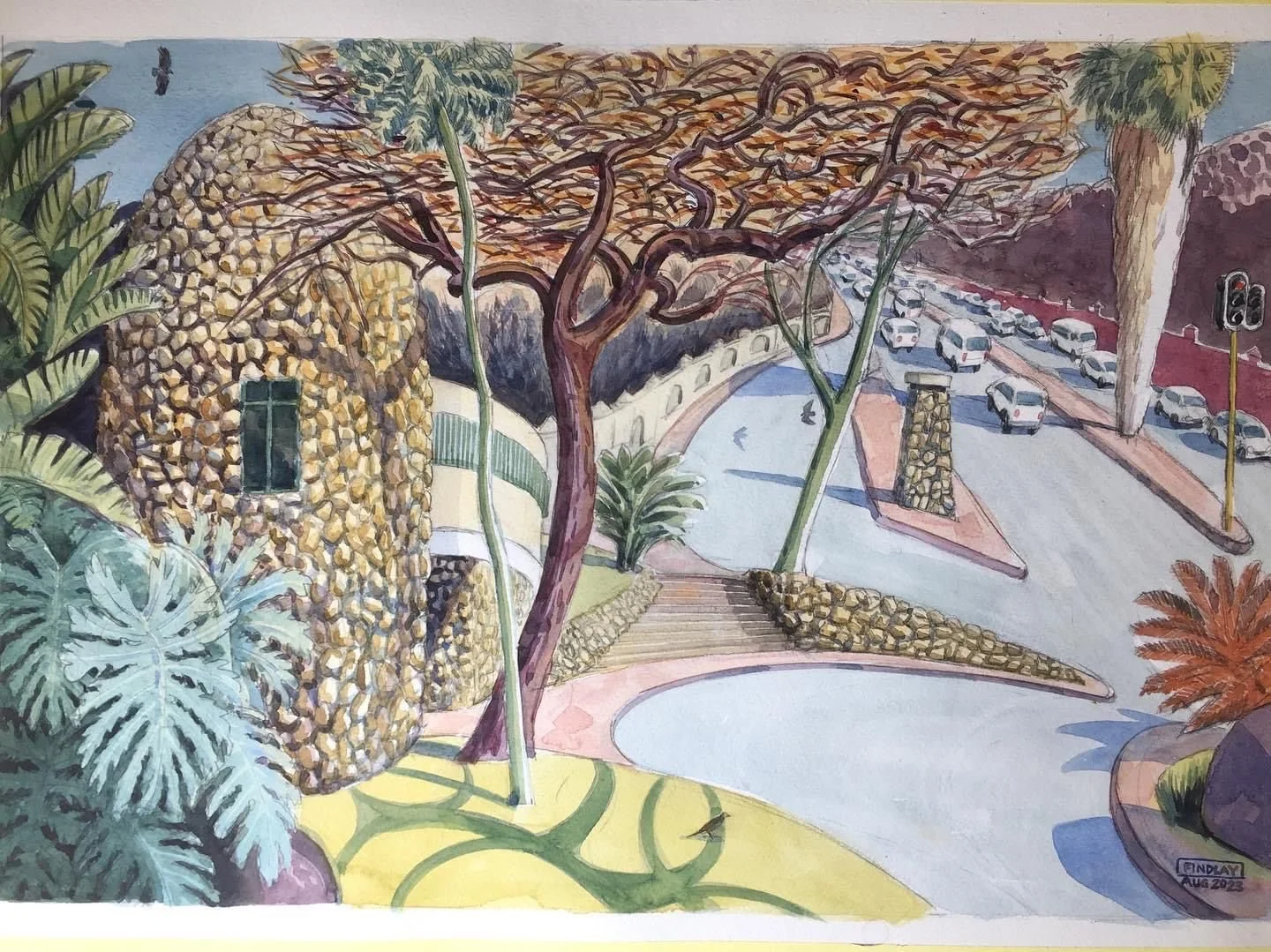
My paintings of Cape Town show the experience of being “the same, and different”. I look self-conscious and ill-at- ease, a large pink skinned, breasted female body, tight-roping on a red and white striped tape used to cordon off holes in the road, the brown skinned, Muslim, neighbours' wives wearing modest attire.
I attended university graduating in fine art in 1984 a mature student with two children where I met many of the artists featured in these podcasts.
I made “The Jol Series” of drawings and won a place on the Cape Town Triennial. I was an invited artist at the SA National Gallery Cape Town.
I taught Art during apartheid (1950s–1980s), later completing a master's degree in art psychotherapy (Derby University) in response to the trauma I was having to deal with from the children I taught who had all witnessed political violence of some kind.
I occupied a studio at The Bag Factory in Johannesburg from 1990 until 1995, next to Deborah Bell and David Koloane.
The Bag Factory is known as one of the leading visual arts facilities in Johannesburg and was co-founded by British philanthropist Robert Loder. It functions as a non-profit residency where artists share the space and ideas. At the time, the space provided studios for predominantly Black artists who had little to no access to resources that could support their careers. Situated in Fordsburg between the Newtown Cultural Precinct and the Oriental Plaza, it is accessible. Artists such as William Kentridge, Penny Siopis, Ricky Burnett, Deborah Bell and Pat Mautloa are some of the successful local alumni artists of the residency programme at The Bag Factory.
The organisation has expanded over two and a half decades and developed as a facilitator and educator and is continues to connect artists to the local and international art world. It has become a hub for cultural exchange and plays an important role in cultivating and promoting South African artists.
Whilst in the Bag Factory I made the series of drawings Art & The Media, and my first solo show, The Jol Series was opened by William Kentridge at The Market Gallery in Newtown in 1992. I was included in the Standard Bank Exhibition at the Market Gallery with artists like William Kentridge.
The exhibition Art and the Media was a 1991 exhibition I curated. I invited South African women artists and activists Sue Williamson, and filmmaker Lindy Wilson to participate. It was hosted at the Gertrude Posel Gallery* in Johannesburg. It was about how the Guardian Weekly Mail newspaper showed media and photographs about current political events. The limited number of exhibition catalogues were edited by myself and Sue Williamson, who printed them on a Cannon Photocopier. There is a copy of this catalogue in the Smithsonian Institution and at the University of the Witwatersrand Library.
The exhibition was a powerful reflection on political and social history, interrogating how Wilson, Williamson, and my own subjects (frequently women involved in South Africa's liberation struggle) were represented. I used newspaper clippings and public records, comparing these images to drawings of civil war by Goya. Williamson images were prints of Women Activists, like Winnie Mandela. Lindy Wilson’s film Robben Island featured an interview with Chief Advocate Fikile Bam, who was imprisoned with Nelson Mandela. His son Litha Bam is featured in the podcast talking about his career as an actor.
*Today, Gertrude Posel Gallery operates as the core gallery space within the acclaimed Wits Art Museum (WAM), located on the University of the Witwatersrand (Wits) campus in Braamfontein.

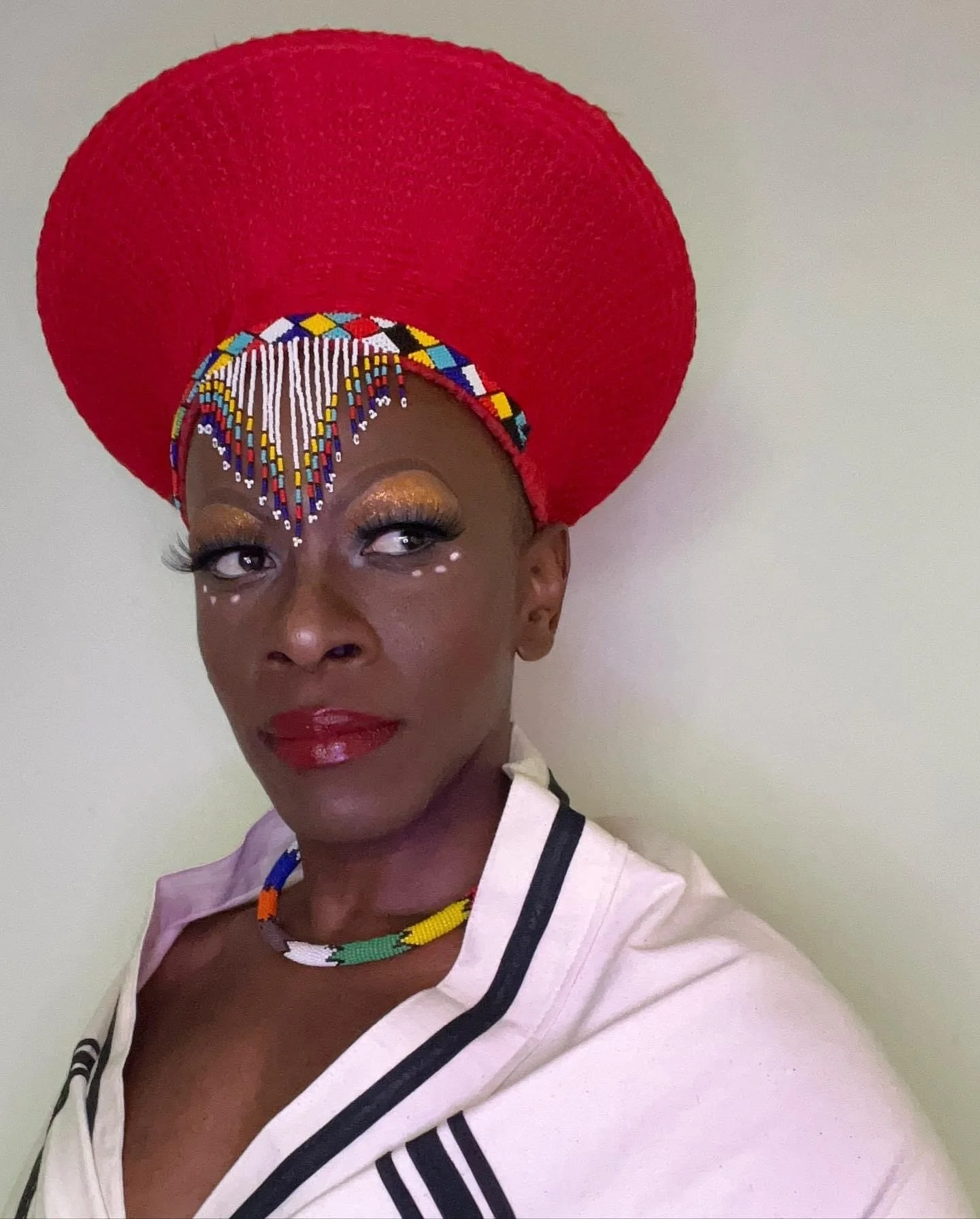
In this episode, we talk with Collen Maswanganyi about the importance of art & the role imagery plays in their stories.